Social Stories: What They Are and How to Write Your Own
On this page
What you can do today
- Pick one specific situation that worries your child (not a whole topic — just one event).
- Jot down the real details: who, what, where, when, and why it happens.
- Write 5–10 short sentences in your child's perspective, present tense and positive.
- Add a photo or symbol to each page so it's easy to follow.
- Read it calmly together a few times before the event — not in the middle of distress.
- After the event, revisit it together and tweak anything that didn't match what happened.
What social stories are and how they help
A social story is a short, personalised piece of writing that describes a situation, event or skill — and gently explains what to expect. Instead of telling a child what to do, a good social story mostly describes: where they'll be, what will happen, who they'll see, how their body might feel, and what usually comes next.
The magic is in making the unknown predictable. A lot of distress for autistic children comes from uncertainty — not knowing what's coming, how long it will last, or what's expected of them. A social story answers those questions in advance, in calm and literal language, so a confusing situation becomes a familiar one.
Social stories can help your child:
- Feel less anxious about something new or unpredictable
- Understand what's expected in a clear, concrete way
- Learn what other people might be thinking or feeling
- Prepare for a change before it happens
- Remember a coping strategy they can use when things feel hard
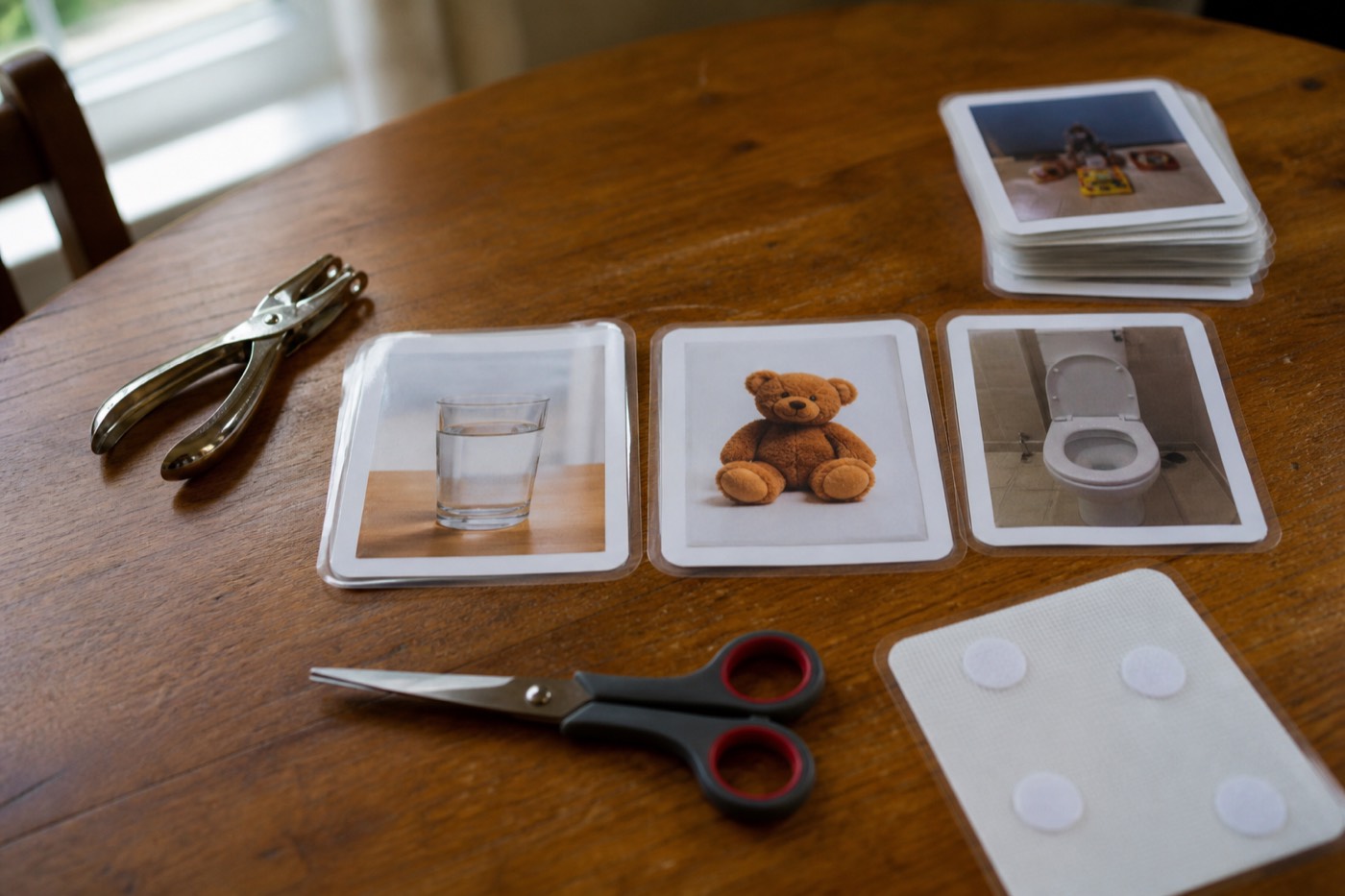
They work best as one tool among several. Pair them with a visual schedule for the order of the day, and with picture communication cards so your child can still tell you what they need in the moment.
When to use a social story
Social stories shine whenever a situation is new, unpredictable, or repeatedly tricky. Common moments parents write them for include:
- New experiences — the first day at a new school, a hospital visit, a haircut, a flight, a dental check-up, a birthday party
- Transitions and changes — moving house, a new sibling, a substitute teacher, the end of the summer holidays
- Recurring difficulties — taking turns, waiting in a queue, washing hands, putting on a seatbelt, lining up at school
- Understanding others — why a friend looked sad, why people say "hello," why we use a quiet voice in the library
- Coping strategies — what to do when feeling angry, how to ask for a break, where the calm-down corner is
A social story is a preparation and teaching tool, not a crisis tool. The moment your child is already overwhelmed or melting down is not the time to read one — that's the time to keep things safe and calm and reduce input. Read the story when everyone is relaxed, well before the event, so the words have a chance to land. If your child struggles broadly with new routines, it's worth also reading about coping with change, which pairs naturally with social stories.
How to write a social story step by step
You don't need special training to write a helpful social story. Here's a simple process:
1. Pick one specific situation
Choose a single, concrete event — "going to the dentist," not "being brave." The narrower the focus, the more useful the story.
2. Gather the real details
Note the who, what, where, when and why. What will the room look like? What sounds, smells or steps are involved? Accuracy matters — if you promise it'll be quick and it isn't, the story loses trust.
3. Write from your child's point of view
Use the first person and present tense where it fits: "Today I am going to the dentist." Keep it positive and reassuring, never threatening.
4. Be concrete and literal
Avoid idioms, sarcasm and vague words. Say "I sit in a big chair that moves up and down" rather than "the dentist works their magic."
5. Mostly describe; coach only a little
Lean on descriptive sentences that explain what happens and how people feel. Add only a few gentle coaching sentences that suggest what your child can do — for example, "I can hold my soft toy" or "I can ask for a break." Too many instructions turn a calming story into a list of demands.
6. Keep it short and at their level
Aim for a handful of short sentences pitched at your child's understanding. Younger children may need just a few pages with one idea each.
7. Add pictures and end on reassurance
A photo or symbol on each page makes the story easier to follow and revisit — the symbol library can help. Finish with a calm, positive ending: "When we are finished, we go home. The dentist helps keep my teeth healthy."
A worked example
Here's a short, original example for a common worry — the fire alarm at school. Notice how most sentences simply describe, with only a couple gently coaching what to do.
"When the fire alarm rings at school"
- Sometimes the fire alarm at school makes a loud ringing sound. (descriptive)
- The alarm is loud so that everyone can hear it. It is doing its job. (descriptive)
- The loud sound can feel surprising or uncomfortable. Lots of children feel that way. (descriptive — and reassuring)
- When the alarm rings, my teacher helps everyone walk outside together. (descriptive)
- I can cover my ears with my hands if the sound is too loud. (coaching)
- I can walk next to my teacher or a friend to the safe spot outside. (coaching)
- We wait outside until a grown-up says it is okay to go back in. (descriptive)
- Most of the time, the alarm is just a practice. Everyone is safe. (descriptive — and reassuring)
That's the whole story — short, literal, and honest about how it might feel. You can copy this shape for almost anything: state what happens, name the feelings, suggest one or two helpful actions, and end with safety and calm.
Using social stories effectively
Writing the story is only half the job — how you use it matters just as much.
- Read it calmly, ahead of time. Share it when your child is relaxed, and read it more than once. Repetition builds familiarity, which is exactly what reduces the anxiety.
- Pair it with other visuals. A social story explains the why and what to expect; a visual schedule shows the order of steps. Together they're stronger than either alone.
- Keep the language consistent. Use the same words in the story that you and school use in real life, so there are no surprises.
- Combine it with communication tools. Make sure your child can still say "help," "break" or "all done" in the moment with picture communication cards — a story prepares them, but they still need a voice.
- Update it as your child grows. Revisit and revise the story as situations change or your child masters a skill. Some stories can be retired once they're no longer needed.
- Never use it as a threat or punishment. A social story is a kind, supportive explanation — not "read this or else." Keep the tone warm so your child trusts it.
Save your stories somewhere easy to find (a folder, a small album, your phone) so you can reach for the right one before the next appointment, party or change.
Frequently asked questions
What is a social story?
A social story is a short, personalised description of a situation, event or skill, written in clear and literal language. It explains what will happen, what your child might see and feel, and what they can do — so a new or confusing situation becomes predictable and less frightening.
How do social stories help autistic children?
They reduce anxiety by removing uncertainty. Many autistic children find the unknown stressful, and a social story answers the questions in advance — where we're going, what happens, how it might feel, and what to do. They also gently teach social understanding and coping strategies in a calm, non-demanding way.
How do I write a social story?
Pick one specific situation, gather the real details, and write a handful of short sentences from your child's point of view in positive, concrete language. Use mostly descriptive sentences with just a few gentle suggestions, add a picture to each page, and finish on a reassuring note.
How long should a social story be?
Short — usually a handful of sentences or a few simple pages. Pitch it at your child's level of understanding; younger children often do best with one idea and one picture per page. If it's too long or too detailed, it can become overwhelming rather than calming.
When should I read a social story to my child?
Read it when everyone is calm and well before the event, and revisit it a few times so it becomes familiar. Avoid reading it in the middle of distress or a meltdown — that's a time for safety and reducing input, not for new information.
Can I use pictures in a social story?
Yes, and it usually helps. A photo or symbol on each page makes the story easier to follow, more engaging, and simpler to revisit. Real photos of the actual place or people can be especially reassuring; a symbol library is handy when you don't have a photo.
Sources and content notes
Published by Autism Parent Guide. This is general educational information.
Clinical review involvement
General practitioner (GP) — name withheld
A general practitioner (GP), who prefers to remain anonymous, has been involved in reviewing the site since its development began and as content has been added. This describes ongoing involvement in the site. Individual article review dates and the scope of each review are not currently published.
References for this guide
- Difficulties at break times: guidance for parents and carersNational Autistic Society
- Autism: communication and speech-language supportASHA
Content updated . This date records an editorial change, not a clinical review. Read our editorial policy or report a correction.
Keep reading & doing
Not medical advice. This article is general information, not a substitute for professional assessment. Every child is different — always talk to a qualified professional about your individual child.