What Is Autism? A Plain-Language Guide for Parents
On this page
What you can do today
- Learn your child's individual profile — what they find easy, hard, calming and overwhelming.
- Reduce unnecessary sensory stress at home (lower noise, softer lighting, predictable routines).
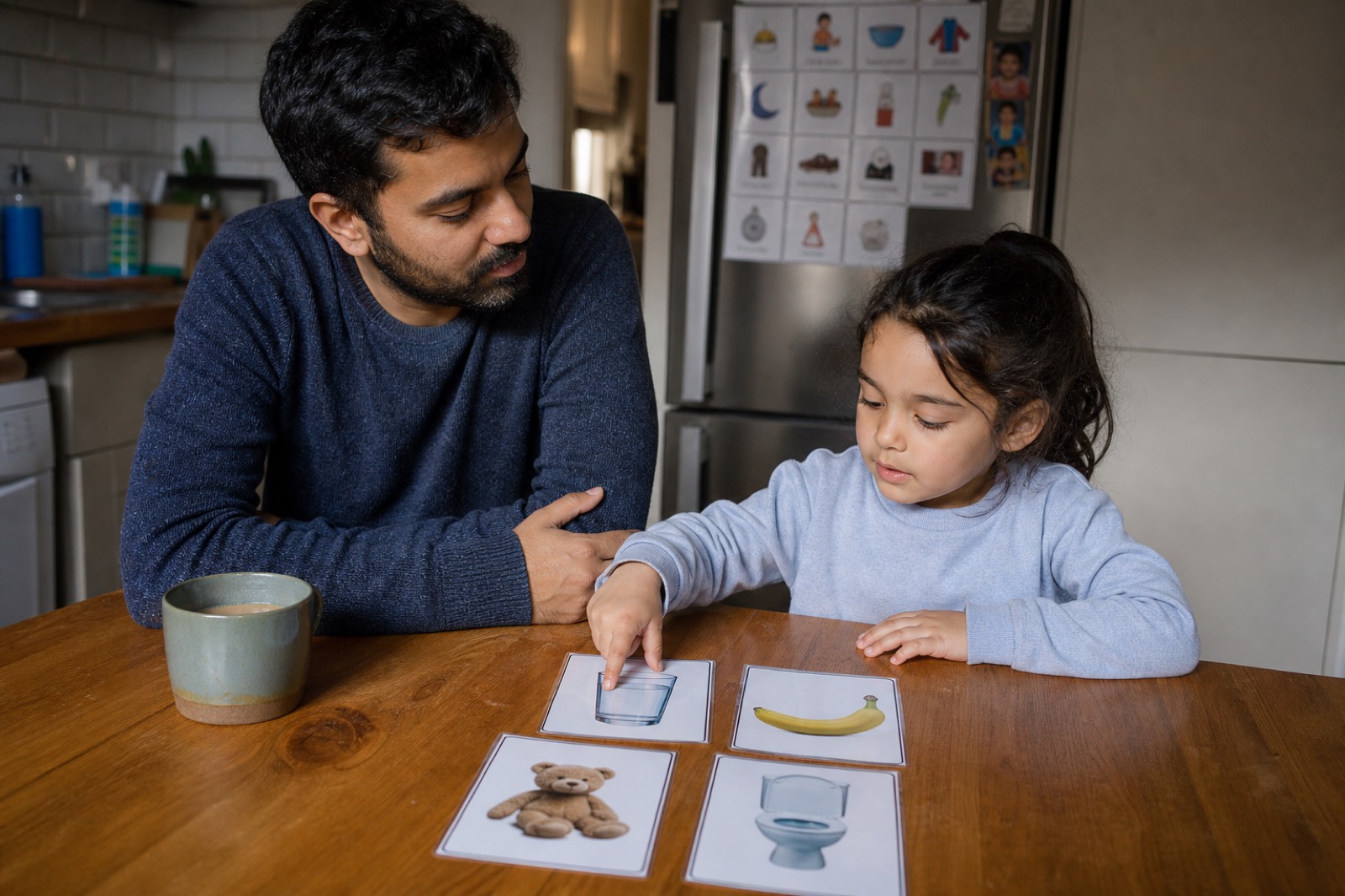
- Use visual supports to make the day predictable and to support communication.
- Connect with other parents of autistic children — practical, emotional and local advice helps.
What does autism actually mean?
Autism is a neurodevelopmental difference — about how the brain develops — not a disease you catch or a parenting failure. It usually shows in social communication, social interaction, and patterns of behaviour, routine and sensory experience. It is lifelong. Support helps a child live in a world that is not always built for them; it does not "remove" autism.
Autism is a neurodevelopmental difference, which means it's about how the brain develops and works. It shapes three main areas of a child's experience:
- Social communication — understanding and using language, gestures, tone and facial expressions, and the back-and-forth of conversation.
- Social interaction — connecting and playing with others, reading social situations, and sharing interests.
- Repetitive behaviours, routines and sensory differences — a need for sameness, deep interests, repeated movements, and being more (or less) sensitive to sounds, lights, textures, tastes and smells.
Autism is lifelong. With understanding and the right support, autistic children grow, learn and thrive — many go on to live full, independent lives. Support is about helping a child communicate and cope in a world that isn't always designed for them, not about changing who they are.
Why is it called a "spectrum"?
Spectrum means autism looks different in every person, and needs can change by setting and over time. One child may talk fluently and still find friendship exhausting; another may not use speech and communicate clearly with pictures. Levels 1–3 and "high functioning" are shorthand, not a full picture of your child.
"Spectrum" means autism shows up differently in every person, and a child's needs can change across situations and over time. One autistic child might talk a lot but find friendships confusing; another might not use spoken words but communicate clearly with pictures or a device.
You may hear people describe "support needs" as low, medium or high, or talk about levels 1–3. These can be useful shorthand, but they don't capture the full picture of a real child who may need lots of help in one area and very little in another. The most useful description is always your child's individual profile.
How is autism different from ADHD, anxiety or a "phase"?
Lots of children are shy, fussy or energetic. Autism is a pattern across communication, interaction and sensory/routine differences, not one behaviour. ADHD can overlap (AuDHD). Anxiety is common in autistic children but is not the same thing. A professional assessment looks at the whole pattern over time, not a single afternoon.
Parents often ask whether what they are seeing is "just personality," ADHD, anxiety, or autism. Those can overlap, and many autistic children also have ADHD or anxiety — see autism and ADHD and autism and anxiety.
| You might be seeing | Often looks like | What usually distinguishes autism |
|---|---|---|
| Shyness | Quiet with strangers | Autism is a pattern at home and with familiar people, plus sensory/routine differences |
| ADHD | Fidgeting, not sitting | Autism adds social-communication differences and intense sameness; ADHD is more about attention and impulse |
| Anxiety | Avoiding school or crowds | Anxiety can be the result of autistic overload; treating only anxiety misses sensory and communication needs |
| A toddler phase | Lining up toys, tantrums | Frequency, intensity, several areas at once, and missed social milestones |
You do not have to pick one label before you ask for help. Describe what you see. The signs by age page and the signs notes sheet are for that conversation — they are not scores.
How common is autism? Estimates vary by country and method. The CDC's ADDM Network has reported autism identification in 8-year-olds in the US in recent surveillance years; the NHS describes autism as relatively common. Treat any single "1 in X" headline as a snapshot from a named source, not a diagnosis of your child. We do not invent a prevalence number here without a dated primary source on the page.
What strengths do autistic children often have?
Autism isn't only a list of difficulties. Many autistic children and adults bring real strengths:
- Deep knowledge and focus in areas of interest
- Strong memory for detail
- Honesty and a clear sense of fairness
- Noticing patterns others miss
- Loyalty and sincerity in relationships
Seeing your child's strengths matters — it shapes their confidence and how the world responds to them.
A note on language
You'll see both "autistic child" (identity-first) and "child with autism" (person-first). Many autistic people and families prefer identity-first language; others prefer person-first. Both are used respectfully on this site. The best approach with any individual family is simply to ask what they prefer.
Autism is widely recognised as a disability, and it can also be a core part of identity. Both things can be true at once.
What to read next
- Wondering if your child is autistic? See the signs of autism in children.
- Worried and not sure where to start? Read what to do if you're worried.
- Curious about why autism happens? See what causes autism.
- Need practical help now? Explore the free Parent Toolkit.
More on what is autism
What causes autism?
A clear, evidence-based answer to what causes autism — the role of genetics and brain development, what's still unknown, and the myths to ignore (including vaccines).
Autism in girls
How autism can look different in girls, the signs that are often overlooked, why so many girls are diagnosed late, and what to do if you think your daughter may be autistic.
Autism levels explained
What autism levels 1, 2 and 3 mean, what 'high functioning autism' really means, and how Asperger's fits in — decoded in plain language for parents.
PDA (demand avoidance)
What PDA (pathological demand avoidance) is, how to recognise it, why ordinary parenting strategies backfire, and low-demand approaches that actually help.
Masking
What autism masking (camouflaging) is, why children mask, the warning signs, the link to burnout and after-school meltdowns, and how to help your child unmask safely.
Stimming
What stimming is, why autistic children do it, whether you should stop it, and how to tell harmless stimming from self-harm — a calm, affirming guide for parents.
Autistic burnout
What autistic burnout is, why children regress, lose skills or withdraw, how it differs from depression, and how to help your child recover and prevent it.
Autism and ADHD
Many autistic children also have ADHD. How autism and ADHD overlap and differ, signs of both, getting assessed, and how to support an AuDHD child at home.
Special interests
Why autistic children develop intense special interests, why they're a strength not a problem, and how to use them to support learning, communication and calm.
Therapies & support
A clear, balanced overview of the therapies and supports families hear about — speech therapy, occupational therapy, and behavioural approaches — and how to choose what's right.
Early support
Why early support matters, what it actually looks like day to day, and the everyday things parents can do to help an autistic toddler or young child thrive.
Future & independence
A reassuring, practical look at autistic adulthood — building independence and life skills over time, planning transitions, work and living options, and hope for the future.
Frequently asked questions
Is autism a disability?
Yes — autism is recognised as a developmental disability, and autistic people are protected under disability and equality law in most countries. Many autistic people also see it as a difference and a part of their identity. Both views can sit together.
Is autism a mental illness?
No. Autism is a lifelong neurodevelopmental difference in how the brain works, not a mental illness and not something that comes and goes. Autistic people can experience mental-health conditions (like anxiety) as anyone can, which is why understanding and support matter.
Can autism be cured?
No, and it doesn't need to be. Autism is part of how a person is wired. The goal of support is to help an autistic child communicate, learn and feel comfortable — not to make them non-autistic. Be cautious of anyone promising a "cure."
Will my autistic child be able to talk?
Many autistic children develop spoken language, some later than usual. Some communicate mainly through pictures, signs or a device, and that is communication too. Supporting all forms of communication early — including picture cards — helps a child connect now, whatever their spoken language journey looks like.
Does autism get worse with age?
Autism itself doesn't get worse. With understanding and support, most children make progress and learn new skills. Stress, change and unmet needs can make a hard day harder — which is why predictable routines and good support make a real difference.
Sources and content notes
Published by Autism Parent Guide. This is general educational information.
Clinical review involvement
General practitioner (GP) — name withheld
A general practitioner (GP), who prefers to remain anonymous, has been involved in reviewing the site since its development began and as content has been added. This describes ongoing involvement in the site. Individual article review dates and the scope of each review are not currently published.
References for this guide
Content updated . This date records an editorial change, not a clinical review. Read our editorial policy or report a correction.
Keep reading & doing
Not medical advice. This article is general information, not a substitute for professional assessment. Every child is different — always talk to a qualified professional about your individual child.