Autism Sensory Overload: Signs and How to Help
On this page
What you can do today
- Notice the *earliest* signs your child shows when input is building up — before crisis hits.
- When you see them, reduce input fast: leave the room, turn down noise and light, give space.
- Use few, calm words (or a picture card) instead of explaining or reasoning mid-overload.
- Keep a small "sensory kit" ready — ear defenders, sunglasses, a fidget, a favourite item.
- Set up one quiet, comforting corner at home your child can go to *any* time, never as punishment.
- Start a simple sensory diary: note what happened before, the trigger, and what helped.
What sensory overload is
Every brain takes in information through the senses and decides what to notice and what to filter out. For many autistic children the volume dial on this is turned up (or sometimes down), so ordinary input can feel far more intense — or harder to feel at all. When more comes in than the nervous system can sort and cope with, the result is sensory overload.
Hyper- and hypo-sensitivity
Children can be hyper-sensitive (over-responsive) — a hand dryer sounds painful, a clothing label feels unbearable, supermarket lighting is overwhelming. Or they can be hypo-sensitive (under-responsive) — they may not register sounds, seem not to feel cold or pain, or need lots of movement and pressure to feel "just right." The same child is often hyper-sensitive in one sense and hypo-sensitive in another.
The eight senses
Most of us learn five senses, but there are eight that matter here:
- Sight — light, colour, movement, busy patterns
- Sound — volume, sudden noises, background hum
- Smell — perfume, food, cleaning products
- Taste — flavours and the feel of food in the mouth
- Touch — textures, clothing, being touched unexpectedly
- Balance (vestibular) — movement, spinning, heights
- Body position (proprioception) — where the body is in space; the pull of muscles and joints
- Internal signals (interoception) — hunger, thirst, needing the toilet, a racing heart
When one or several of these are flooded, the thinking, reasoning part of the brain goes offline. That's why overload can spill into a meltdown (an outward, explosive response) or a shutdown (going quiet, still, withdrawn or "switched off"). Both are signs of a nervous system that has hit its limit — not of a child being difficult.
Signs of sensory overload
Overload usually builds, so there are often early signs before a child reaches crisis. Learning your own child's cues is one of the most useful things you can do, because acting early is far easier than calming a full meltdown.
Early signs
- Covering ears or eyes, squinting, or hiding their face
- Looking distracted, tense, fidgety or "wired"
- More stimming than usual — rocking, hand-flapping, pacing, humming
- Becoming irritable, clingy or unusually quiet
- Complaining a place is too loud, too bright or "too much"
Escalating signs
- Refusing to go into a room, shop or event
- Freezing on the spot, or trying to flee
- Putting hands over the head, curling up, or seeking a corner
- Tearfulness, shouting, or sudden aggression
- A meltdown, or a shutdown where they go silent and unreachable
Every child is different — one may cover their ears and bolt, another may go quiet and float away. There's no single checklist. Watch for your child's pattern, and treat the early signals as a request for help, not misbehaviour.
Sensory seeking vs sensory avoiding
Two children can both have sensory differences and look completely opposite. Understanding which way your child leans — and remembering it can vary by sense and by day — helps you give the right support.
Sensory avoiders
Avoiders are easily overwhelmed and pull away from input. They might:
- Cover their ears in noisy places or melt down at hand dryers and vacuum cleaners
- Hate certain clothing textures, labels or seams
- Avoid messy play, sticky food or being touched unexpectedly
- Find crowds, bright lights or strong smells unbearable
Avoiders need input reduced: quieter spaces, softer lighting, warning before touch, and tools like ear defenders.
Sensory seekers
Seekers crave more input and go looking for it. They might:
- Love spinning, jumping, crashing, climbing and rough-and-tumble
- Touch everything, chew non-food items, or seek tight squeezes and bear hugs
- Make loud noises or enjoy very loud sound
- Struggle to sit still and seem to be "always on the go"
Seekers usually do better with input added safely: movement breaks, deep pressure, fidgets, safe chew items and active play. Meeting that need on purpose often reduces disruptive seeking.
Map your child
Most children are a mix — perhaps a sound avoider but a movement seeker. A simple sensory diary (jot down the place, the input, your child's reaction and what helped) builds a picture over a couple of weeks. That profile is gold for an occupational therapist and for everyday planning.
What to do during sensory overload
When your child is overloaded, this is not the moment to teach, reason or correct — their thinking brain is overwhelmed. Your job is to bring the input down and help their nervous system settle.
Reduce the input — fast
This is the single most important step. Leave the environment if you can, or quickly lower what's flooding them: turn down or off the noise, dim the lights, move away from the crowd, switch off the screen. Less is more.
Give space and time
Don't crowd them. Recovery isn't instant — let them have a few quiet minutes without new demands. A calmer, dimmer, less busy spot helps enormously.
Say very little
Lots of talking is more input to process. Use few, calm, low words — or a picture card — and a gentle tone. Questions and explanations can wait.
Offer comfort their way
Some children settle with deep pressure — a firm hug, a weighted lap pad, being wrapped in a blanket. Others can't bear touch when overwhelmed and need distance. Offer what your child finds soothing and follow their cues rather than imposing what you'd want.
Plan exits in advance
For outings, decide your escape route before you need it: where the quiet space is, where the car is, a code word your child can use. Knowing there's a way out lowers everyone's stress and makes overload easier to catch early.
Reducing overload day to day
You can't remove every trigger, but you can make daily life far gentler on your child's nervous system. Think of it as turning down the background "noise" so they have more capacity for everything else.
A more sensory-friendly home
- Soften lighting — lamps instead of harsh overhead lights, blinds to cut glare, and avoid flickering bulbs
- Lower noise — close doors, use rugs and soft furnishings, mute background TV, and consider quieter appliances
- Declutter busy, visually "loud" spaces, especially where your child relaxes
- Watch smells — fragrance-free cleaning and washing products help many children
A small sensory toolkit
- Ear defenders or noise-reducing earplugs for loud places
- Sunglasses or a cap for bright environments
- Fidgets for hands that need to move
- Safe chew items designed for chewing (never small or breakable objects — choose age-appropriate, sturdy chewable tools and supervise)
Routines, breaks and quieter timing
- Keep the day predictable — a visual schedule and warnings before changes lower anxiety and free up coping capacity
- Build in regular sensory breaks before your child is running on empty, not only after a meltdown
- Protect recovery time, especially after school, before any new demands
- Visit busy places at quieter times — early mornings, off-peak hours, or sensory-friendly sessions some shops and cinemas now offer
Professional support
An occupational therapist (OT) can assess your child's sensory needs and suggest a personalised plan, sometimes called a "sensory diet" — a tailored mix of activities through the day to help your child stay regulated. This works best when it's individual and OT-guided rather than copied from a list online. Ask your GP, paediatrician or school about a referral. Good support reduces distress and helps your child thrive — it isn't about changing who they are.
Building a calm-down corner at home
A calm-down corner gives your child a reliable, safe place to retreat and regulate. It doesn't need to be fancy or cost much — what matters is that it's always available and feels good to them.
Step by step
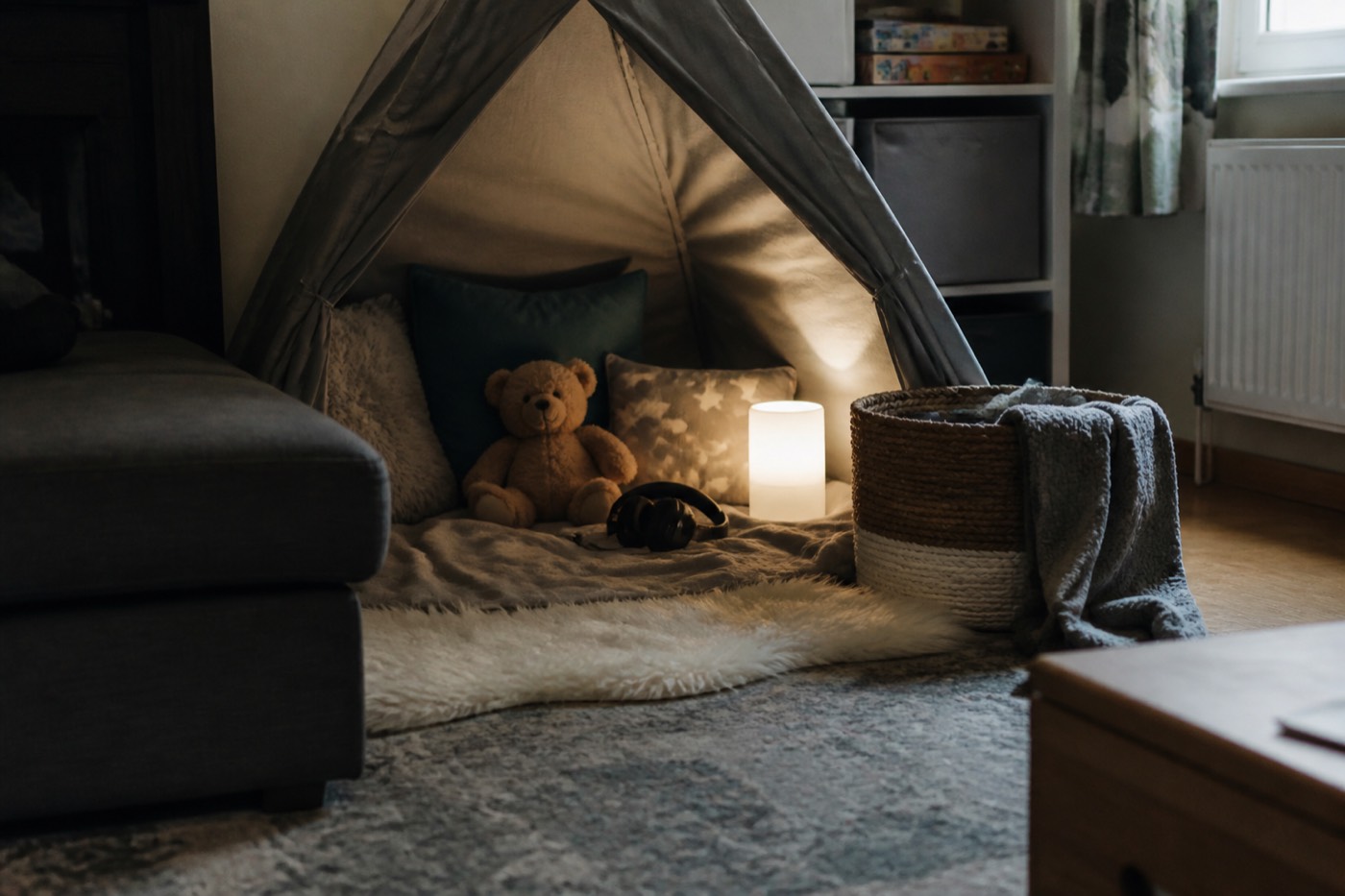
- Pick a low-traffic spot — a quiet corner, a bedroom nook, under a loft bed, or a pop-up tent. Away from doorways and the busiest rooms.
- Soften light and sound — fairy lights or a lamp instead of harsh overhead light; a rug, cushions or curtains to muffle noise.
- Add comforting items — soft cushions, a blanket (a weighted one if your child likes deep pressure and it's safe and right for their age), a favourite toy, fidgets, headphones, or a calming book.
- Let your child help choose what goes in — it works far better when it's theirs.
Make it work
- Keep it positive — never a punishment spot. A calm-down corner is a safe haven, not "time out." If it's ever used as a consequence, your child won't trust it.
- Teach it when everyone is calm, not mid-meltdown. Practise going there together, so using it becomes familiar.
- Encourage proactive use — the goal is your child learning to head there before they're overwhelmed.
- Pair it with a "break" card so your child can ask to use it even when words are hard. A simple picture card for "break" or "too loud" lets them signal a need before overload takes over.
One quiet corner and one "break" card are two of the simplest, most powerful tools you can set up this week.
Frequently asked questions
What does sensory overload look like in an autistic child?
It varies a lot, but common signs include covering ears or eyes, looking distressed or distracted in busy or loud places, more stimming than usual, becoming irritable or very quiet, refusing to enter somewhere, freezing, trying to flee, or melting down. Some children go the opposite way and shut down — going silent and withdrawn. Learning your own child's early cues lets you step in before crisis.
Is sensory overload the same as a meltdown?
Not quite — they're closely linked. Sensory overload is when the nervous system receives more input than it can process. A meltdown is one possible result, when that overwhelm spills out as an intense, involuntary response. Overload can also lead to a quieter shutdown, or be eased before a meltdown happens if you reduce the input early.
Why does my child cover their ears at loud noises?
Covering the ears is a natural way to reduce input that feels genuinely overwhelming or even painful. Many autistic children are hyper-sensitive to sound, so everyday noises — hand dryers, vacuum cleaners, busy halls — can feel far more intense to them than to others. It's a self-protective response, not attention-seeking. Ear defenders or earplugs in noisy places often help a great deal.
Is my child a sensory seeker or a sensory avoider?
Many children are both, depending on the sense. Avoiders pull away from input — covering ears, hating certain textures, avoiding crowds. Seekers crave input — spinning, crashing, chewing, seeking tight hugs and movement. Keeping a short sensory diary over a couple of weeks (noting the place, the input and your child's reaction) helps you map their profile and is very useful for an occupational therapist.
How do I make my home more sensory-friendly?
Focus on turning down everyday background input. Soften lighting with lamps and blinds, reduce noise with rugs, soft furnishings and quieter appliances, declutter the spaces where your child relaxes, and switch to fragrance-free products if smells are a trigger. Add a quiet calm-down corner and keep simple tools like ear defenders and fidgets handy. Small changes across the day add up.
Do ear defenders and fidget toys actually help?
For many children, yes. Ear defenders or noise-reducing earplugs can make loud, unavoidable places — assemblies, shops, parties — far more manageable for sound-sensitive children. Fidgets give busy hands the movement or pressure they crave, which can help a sensory seeker stay calm and focused. They aren't magic and won't suit every child, so try them and follow what genuinely helps yours.
Sources and content notes
Published by Autism Parent Guide. This is general educational information.
Clinical review involvement
General practitioner (GP) — name withheld
A general practitioner (GP), who prefers to remain anonymous, has been involved in reviewing the site since its development began and as content has been added. This describes ongoing involvement in the site. Individual article review dates and the scope of each review are not currently published.
References for this guide
- Sensory processingNational Autistic Society
- Autism in under 19s: support and managementNICE CG170
Content updated . This date records an editorial change, not a clinical review. Read our editorial policy or report a correction.
Keep reading & doing
Not medical advice. This article is general information, not a substitute for professional assessment. Every child is different — always talk to a qualified professional about your individual child.