Autism and Anxiety in Children: How to Help
On this page
What you can do today
- Name the feeling for your child: "You look worried — that's okay, I'm here." Validation calms faster than reassurance alone.
- Make the next part of the day predictable — tell them what's coming, in order, with a [visual schedule](/daily-life/visual-schedules) or a quick list.
- Lower the load right now: less noise, fewer demands, more space and downtime.
- Give your child a way to *show* worry — a feelings card, a "break" card, or a thumbs-up/down — so they don't have to find the words.
- Build in a calm-down option they like (quiet corner, a favourite item, deep pressure) before the worry peaks.
- Keep a simple note of when anxiety spikes — you'll start to see the triggers.
Why anxiety is so common in autism
Anxiety isn't a flaw or a phase — for many autistic children it's a near-constant background hum, and there are real reasons for it. Understanding the drivers helps you respond to the cause, not just the symptom.
- Uncertainty and change — not knowing what's coming, or having plans change suddenly, can feel genuinely threatening. A predictable world feels safe; an unpredictable one feels alarming. (See coping with change.)
- Sensory overload — when the world is too loud, too bright or too busy, the nervous system stays on high alert. Living with that day after day is exhausting and anxiety-provoking. (More on sensory overload.)
- Social confusion and masking — working out unspoken social rules, and the effort of masking to fit in, drains energy and fuels worry, especially at school.
- Communication frustration — not being able to express a need, or be understood, is stressful in itself.
- A need for things to be clear — ambiguity, vague instructions and "we'll see" can be harder to bear than a firm yes or no.
- Co-occurring conditions — many autistic children also experience things like ADHD, sleep difficulties or stomach problems, which can amplify anxiety.
None of this means your child is fragile. It means their world often asks a lot of them — and small changes on your side can lighten that load.
How anxiety shows up (it's not always obvious)
Most anxious autistic children don't say "I feel anxious." Their distress comes out as behaviour — and it's easy to misread that behaviour as defiance, fussiness or attention-seeking. A helpful reframe: behaviour is communication. When you see these signs, ask "what might my child be worried about?" rather than "how do I stop this?"
Anxiety can look like:
- Avoidance — refusing places, activities, foods or people; suddenly "not wanting" something they used to manage
- Controlling or rigid behaviour — insisting things go a certain way, strong reactions to small changes, lots of rules
- More stimming — increased flapping, rocking, pacing or repeating, which can be self-soothing (see stimming)
- Meltdowns or shutdowns — exploding, or going quiet and withdrawn, when worry overflows (see meltdowns)
- Physical complaints — tummy aches, headaches, feeling sick, needing the toilet a lot, especially before stressful events
- Sleep problems — trouble falling asleep, night waking, early waking (see sleep)
- Reassurance-seeking — asking the same questions over and over, needing to know exactly what will happen
- Irritability or withdrawal — being snappy, tearful, clingy, or pulling away from people
The child who melts down after school, or who can't go to school at all, is often a deeply anxious child who has been holding it together all day. This isn't manipulation — it's a nervous system at its limit.
Reducing what fuels anxiety
You can't remove every source of worry, but you can change the environment and routine so there's less to be anxious about. The single biggest lever is predictability — when a child knows what's coming, the brain can stop scanning for threats.
Make life predictable
- Use a visual schedule so your child can see what's happening and what's next.
- Prepare for changes in advance — talk through new situations, use a social story, or visit a new place at a quiet time first.
- Give clear warnings before transitions: a countdown, a timer, or "two more minutes, then we tidy up."
Lower the sensory and social load
- Cut noise, brightness and crowding where you can; offer ear defenders or a quiet retreat.
- Build in protected downtime, especially after school, before any demands.
Communicate clearly and concretely
- Use short, literal language. Say exactly what will happen, not what won't.
- Avoid vague answers — "maybe later" is harder than "after lunch."
- Offer choice within structure ("red cup or blue cup?") so your child feels some control without being overwhelmed by open-ended decisions.
These aren't about removing all challenge — they're about meeting your child's nervous system where it is, so it has room to settle.
Teaching calming and emotional-regulation tools
Children can't learn a new skill while they're overwhelmed — so the golden rule is to teach and practise calming tools when your child is calm, not in the middle of distress. Then, when worry rises, the tool is already familiar.
Help them name feelings
- Use visuals: feelings cards, a simple emotions chart, or a colour/zone-style system where each colour stands for a feeling and a few matching strategies. Keep it concrete and your own — there's no need for any branded program.
- Naming the feeling ("that's worry") makes it less frightening and easier to manage.
Build a calm-down toolkit
- Body-based calming — slow breathing (blow out like blowing up a balloon), pushing against a wall, a slow walk, a stretch.
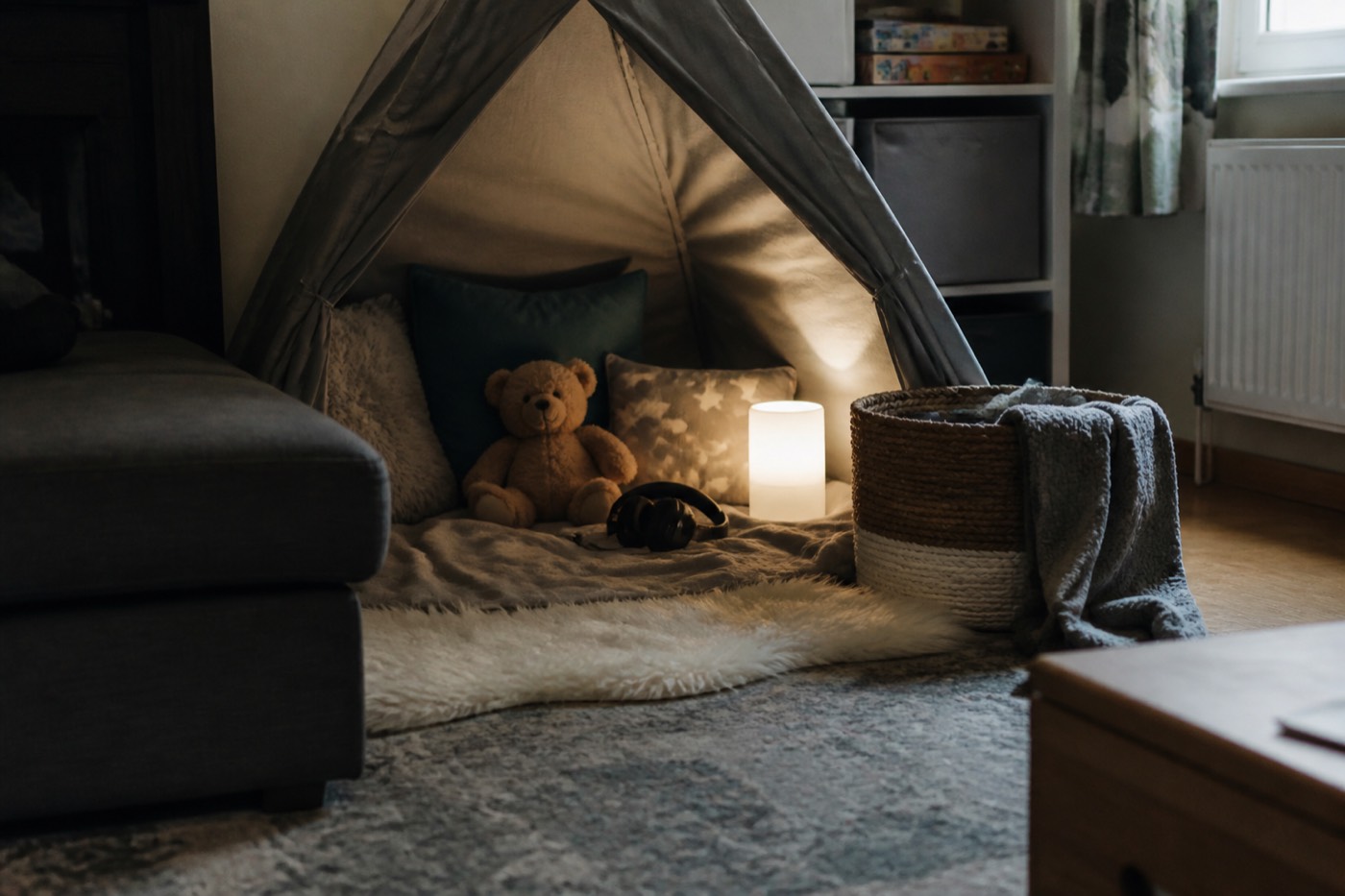
- A calm-down space — a quiet, cosy corner your child can go to before things boil over, never used as punishment.
- Comfort items — a favourite object, fidget, weighted lap pad or blanket (with age-appropriate safety in mind), or deep-pressure input if your child likes it.
- A "break" or "help" card so your child can ask for what they need without words. You can make these with the picture cards approach.
Prepare for worrying situations
- Use social stories to walk through dentist visits, parties or first days, step by step, so the unknown becomes known.
Model calm yourself
- Your calm is contagious. Narrate it gently: "I feel a bit frustrated, so I'm going to take three big breaths." Children learn regulation by borrowing yours first.
When to seek extra support
Everyday strategies help most children most of the time — but sometimes anxiety needs more than home support, and asking for that is a strength, not a failure.
Consider reaching out to a professional if:
- Anxiety is stopping normal life — your child can't eat properly, sleep, leave the house, or attend school (see school refusal)
- You see panic attacks, persistent low mood, or your child seems sad and withdrawn much of the time
- There are signs of self-harm, or your child talks about not wanting to be here
- The whole family is running on empty and you can't see a way forward
Where to turn
- Start with your GP or paediatrician, who can listen, rule out physical causes, and refer on.
- Many areas offer talking therapies adapted for autistic children — therapy often works best when it's adjusted for how your child thinks and communicates, with more visuals and concrete steps.
- Routes such as a children's mental-health service (CAMHS-type teams in some regions) can offer specialist input.
- Medication is a doctor-only conversation — it's sometimes considered, but always alongside, not instead of, the practical support above.
There's no "cure" for anxiety, and the goal isn't to make your child stop being autistic — it's to help them feel safe, understood and equipped, so worry takes up less of their day.
Frequently asked questions
How can I tell if my autistic child is anxious?
Anxiety often shows up as behaviour rather than words — avoidance, needing to control things, more stimming, meltdowns or shutdowns, tummy aches, sleep trouble, or asking the same questions over and over. If your child seems on edge before certain events or places, that pattern is usually a clue. Treat the behaviour as a message about how they're feeling.
Why is my autistic child so anxious about small changes?
Many autistic children rely on predictability to feel safe, so an unexpected change can feel genuinely threatening rather than just inconvenient. When the brain can't predict what's next, it stays on alert. Warning your child in advance, using a visual schedule, and talking changes through ahead of time can take a lot of the fear out of them.
What are the best ways to calm an anxious autistic child?
In the moment, validate the feeling ("you look worried, I'm here"), reduce noise and demands, and offer a familiar calming option — a quiet space, deep pressure, a favourite item, or slow breathing. Keep words few and your own voice calm. Tools work best when you've practised them together during calm times, so they're already familiar when worry rises.
Can anxiety cause meltdowns?
Yes, very often. A meltdown is what can happen when overwhelm — including anxiety — builds past what a child can manage. It isn't a choice or a tantrum. Lowering background anxiety with predictability, reduced sensory load and good communication usually reduces how often meltdowns happen.
Do autistic children grow out of anxiety?
Anxiety can ease as children get older, develop coping tools, and find environments that suit them better — but it doesn't reliably just disappear, and some children carry anxiety into their teens and beyond. The good news is that anxiety responds well to support. Building predictability, self-understanding and calming skills now sets your child up to manage it for life.
When should I get professional help for my child's anxiety?
Reach out if anxiety is stopping everyday life — eating, sleeping, leaving the house or going to school — or if you notice panic, low mood, withdrawal, or any sign of self-harm. You should also seek help if your family feels overwhelmed. Start with your GP or paediatrician, who can refer to talking therapies adapted for autistic children and other specialist support.
Sources and content notes
Published by Autism Parent Guide. This is general educational information.
Clinical review involvement
General practitioner (GP) — name withheld
A general practitioner (GP), who prefers to remain anonymous, has been involved in reviewing the site since its development began and as content has been added. This describes ongoing involvement in the site. Individual article review dates and the scope of each review are not currently published.
References for this guide
- AnxietyNational Autistic Society
- Autism in under 19s: support and managementNICE CG170
Content updated . This date records an editorial change, not a clinical review. Read our editorial policy or report a correction.
Keep reading & doing
Not medical advice. This article is general information, not a substitute for professional assessment. Every child is different — always talk to a qualified professional about your individual child.